Considering An Unusual Aesthetic
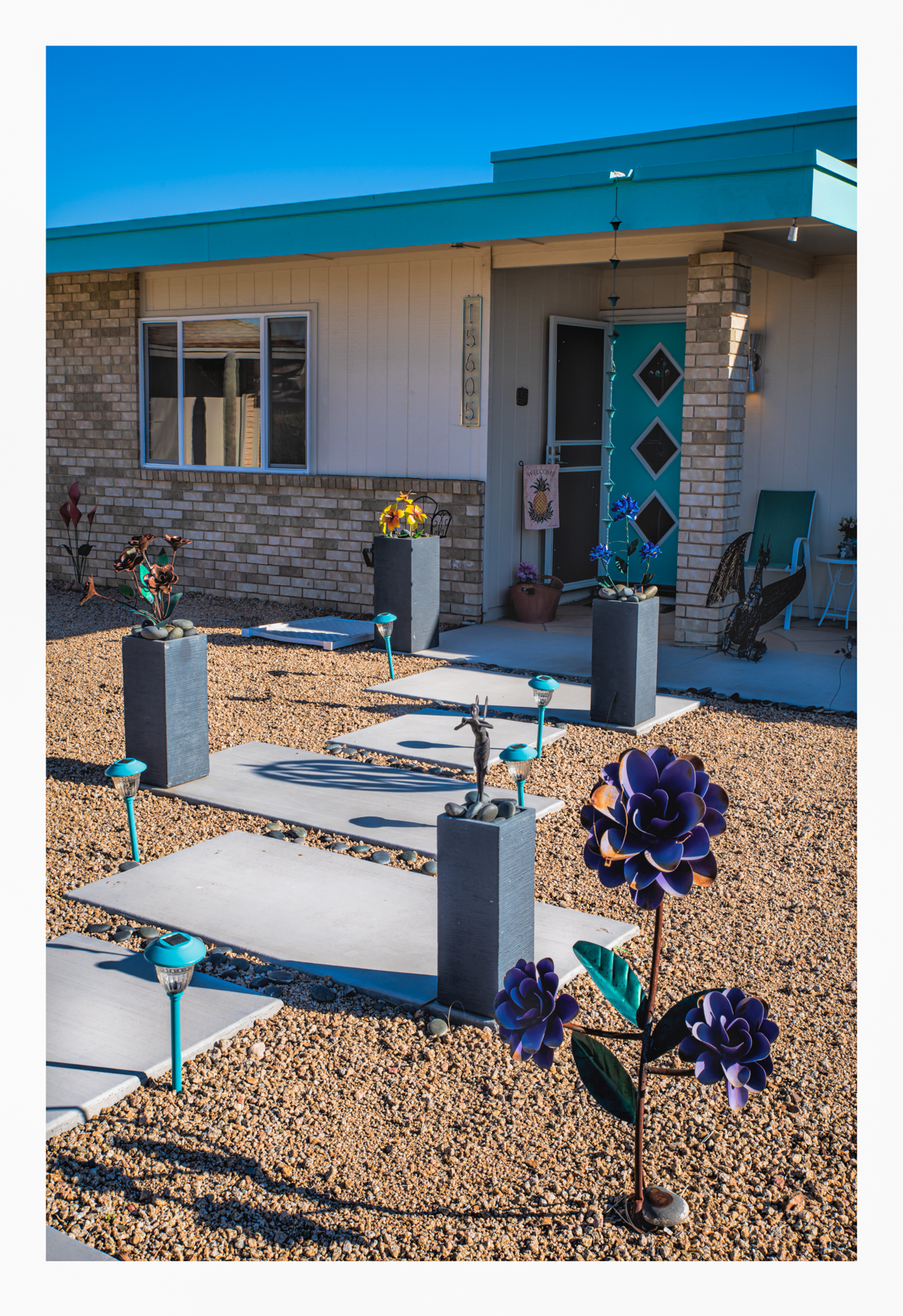
Occasionally a homeowner sets a new standard in front-yard decoration. You have before you such a case. This home in the American desert maintains the status quo with only one element of design: gravel raked over plastic underlayment to cover the ground — a ubiquitous practice, as common as dirt in this vicinity. With the installation of that earth-colored rock, conventionality ends. And idiosyncrasies begin. Without spending time with the creator of this ensemble, observing personality traits which might explain his or her quirky sense of beauty, one clutches for an analogy to help understand this.
Eventually the male bowerbird came to my mind.
The longer I live and study, the more I think we humans learned the basics of what we know about art (and maybe architecture) from observing the behavior of birds and other organisms with whom we share the Earth — many of whom preceded us in evolutionary history by millions of years:
“The promiscuous males of the polygynous bowerbird species are remarkable for their bower-building habits. They not only construct architecturally elaborate structures of sticks and other vegetable matter but also decorate them with numerous and various, often colorful, natural and (where available) human-made objects. In some species, parts of the bower structures are ‘painted’ with natural pigments prepared by the males and sometimes applied with a ‘tool’ of vegetable matter held in the bill to aid control and application of their ‘paint.’ In light of these extraordinary abilities, and associated complex courtship behavior and vocalizations, bowerbirds have long been associated with high intelligence and artistic or esthetic sense beyond those of other birds.”
C.B. Frith, from Encyclopedia of Animal Behavior, 2010
We can rule out hormone-fueled courtship dances in the neighborhood where I made this photograph — also polygyny and fervent vocalizations of love. Nevertheless a preponderance of the details in our picture overlap bowerbird culture. Those animals follow an idiosyncratic way of life, have developed perfection-obsessed artistic sensibilities. They have evolved their own genre of still life, not in its particulars instinctual; their designs may vary according to an individual bird’s tastes, or their creations may sometimes deviate radically from past practices following changes in locally-available materials.
After human beings invented plastics and profusely filled our environment with artifacts made from that substance, bowerbirds began using drinking straws, bottle caps, multi-colored plastic clothespins, and other discarded man-made materials in their artwork. It appears they select items according to their pigmentation, preferring blue objects especially. In previous centuries before modern trash appeared, observers report the avian artists used other assortments of small objects:
“The decorations are very profuse and consist of bivalve shells, crania of small mammalia and other bones. Evident and beautiful indications of design are manifest through the whole of the bower and decorations formed by this species. As these birds feed almost entirely upon seed and fruits, the shells and bones cannot have been collected for any other purpose than ornament; furthermore, it is only those items that have been bleached perfectly white in the sun that attract their attention.”
Elizabeth Gould; John Gould in Birds of Australia Vol. 4, published 1848.
The Goulds describe entrances to bowerbird pavilions festooned with blue tail-feathers, cast off and left on the ground by various species of parrot. Furthermore, there is abundant evidence the birds maintain their cottage-fronts meticulously, allowing nothing to fall out of place, nothing to become faded. These are conditions which might “offend the eye.” A 19th Century writer called these animals Gardener Bowerbirds, and said: “The passion for flowers and gardens is a sign of good taste and refinement.” Some birds of this species appear to have uncanny knowledge of perspective — using it to create artistic illusions (foreshortenings) to demonstrate their superior intelligence to potential wives or lovers.
In our present image it is possible — though with a probability near zero — that this yard-motif aims to attract a fertile female. The local residents have an average age in the mid-80s; many of the men exceed 90 years old. None of these guys are out hunting, hoping to procreate; the majority can barely walk a straight line on a smooth surface.
Like the gardener bowerbird, our homeowner seems fond of blue objects, ranging from navy to turquoise. Notice he/she uses only the smoothest stones in this composition, arranged on top of the four rectangular vertical pillars; the same rocks are lined-up in a staggered pattern on the ground between the slabs of concrete. Emulating the bowerbird, the creator has used ready-to-hand things. The black dragon on wheels seen parked on the front porch certainly was acquired opportunistically, perhaps an impulsive buy at a roadside junk emporium. Likewise the WELCOME tapestry — featuring a ripe pineapple — looks like a random purchase in a gift shop or hardware store. I am guessing the stepping stones can be found close-by, already manufactured.
There are differences between the householder and the gardener bird. Our image suggests a still-life artist with a Euclidean mind, obsessive in his or her own way — one might even call it an excessively orderly (anal-retentive) approach to art. This virtuoso prefers straight lines and hard, sharp angles, unmitigated by serpentine or gently curved elements. He/She likes industrial materials in a tightly structured composition, and spurns the more malleable naturalistic style of the bowerbird.
What are we seeing here?
My conjecture: We might be looking at a trans-human aesthetic sense, passions jointly and widely shared among members of the animal kingdom, especially between human beings and the gardener bowerbird.