Approaching Arabic
Knowledge of Arabic opens a civilization stretching thirteen thousand kilometers wide — from Morocco eastward to Indonesia. In that vast territory not everyone speaks with the Arab tongue in daily life, yet most build their spiritual life upon the Koran, delivered to the Messenger of God Mohamed by visionary experience in the idiom of the Arabian Peninsula. No valid translation can exist according to Muslim scholars; the text must be absorbed and recited in its original form; everything else is considered interpretation, not eternal truth.
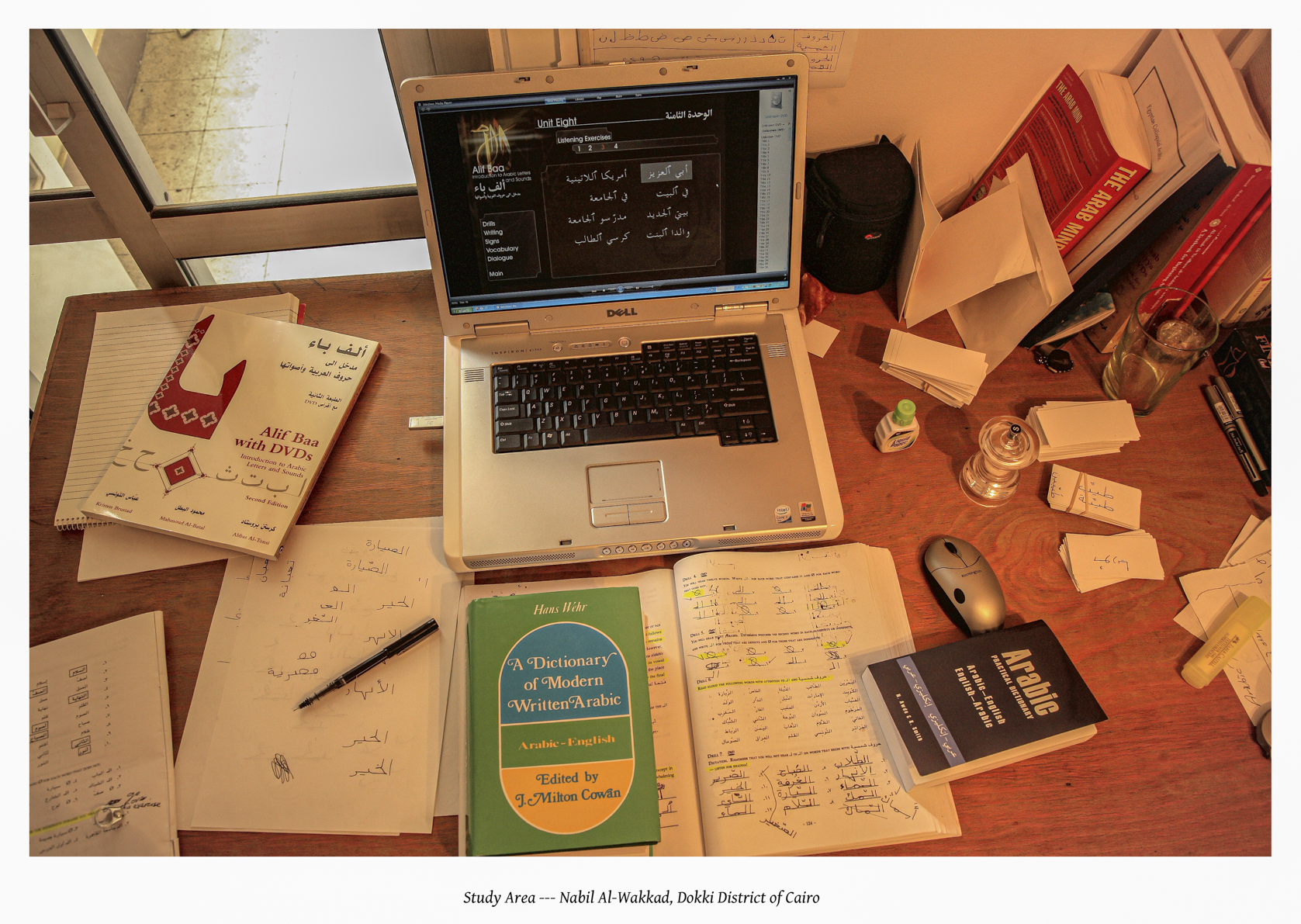
Attempting Arabic in middle-age might be analogous to traversing the Himalayan Plateau on your first backpacking trip. I was not a linguistic virgin. I previously studied two European languages (Spanish & French) and one Semitic (Biblical Hebrew), and dabbled in several others — yet I spent over a year in Egypt and months in Yemen struggling to master fundamentals of Arabic. I enjoyed the exotic alphabet and the algebra of their three-syllable root system, which allows the derivation of a verb tense, or noun-form, on the fly if you have retained just three tiny units (consonants) of sound. When speaking Arabic, a few phonemes make trouble for every child of the English language. Unfamiliar muscles in the neck — barely used by me apart from gargling or choking — had to be activated and conditioned. Intensive practice cost me a sore throat, chronic, lasting the first three of months of my sojourn in the Middle East.