Homage to Edward Hopper
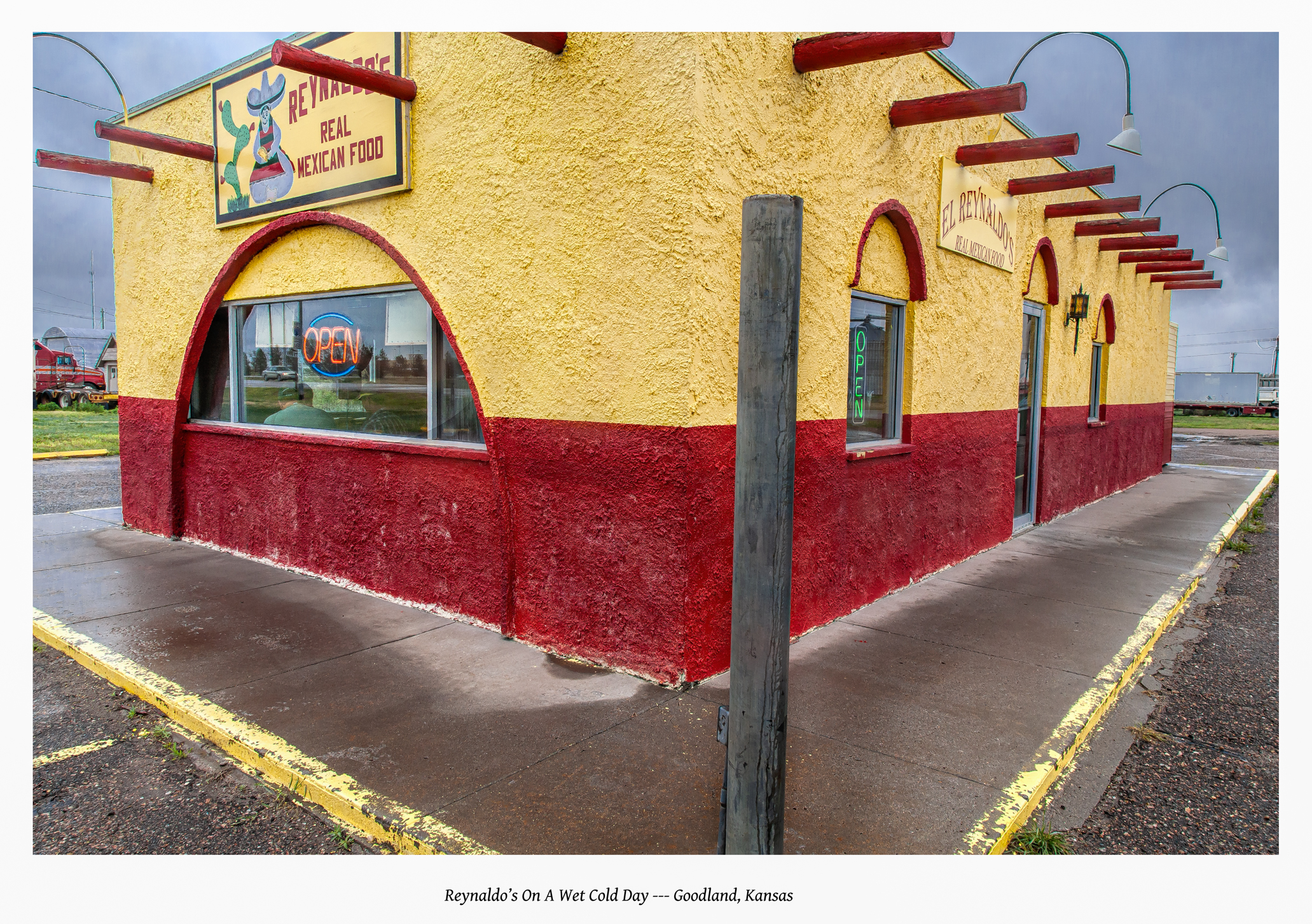
I had driven a thousand miles west stopping just once to sleep. On the high plains of Kansas I ran into sleet and bitter winds. For reasons unknown, I am without luck in these situations; again and again forced into remote towns under heavy weather, where travelers confront poor choices among accommodations. That night — and for the next two running — I recuperated in a motel which itself was undergoing rejuvenation. Paint fumes, the tarps, the mountains of smelly carpet-chunks, dodging to avoid scaffolding and electrical cords, enduring all that clamorous activity finally drained me, sent me into Goodland City seeking calmness, hoping for quiet solitude and a nutritious meal. I found this almost-empty Mexican restaurant next to a railroad yard.
When you recognize a classic Edward Hopper motif in the wild, it is hard to resist working with it. Mr. Hopper could represent a well-lighted space in dark surroundings at will; the hapless photographer by contrast makes the best image possible under conditions chosen by someone else, or shaped by uncontrollable forces: the weather, in this example. It was an overcast day, the cafe interior dimly-lit; nothing the camera operator can do about the circumstances.
Nonetheless, some elements of the scene on the Kansas prairie duplicate the effects created by gazing at The Nighthawks — drawn from an entirely alien, big-city setting:
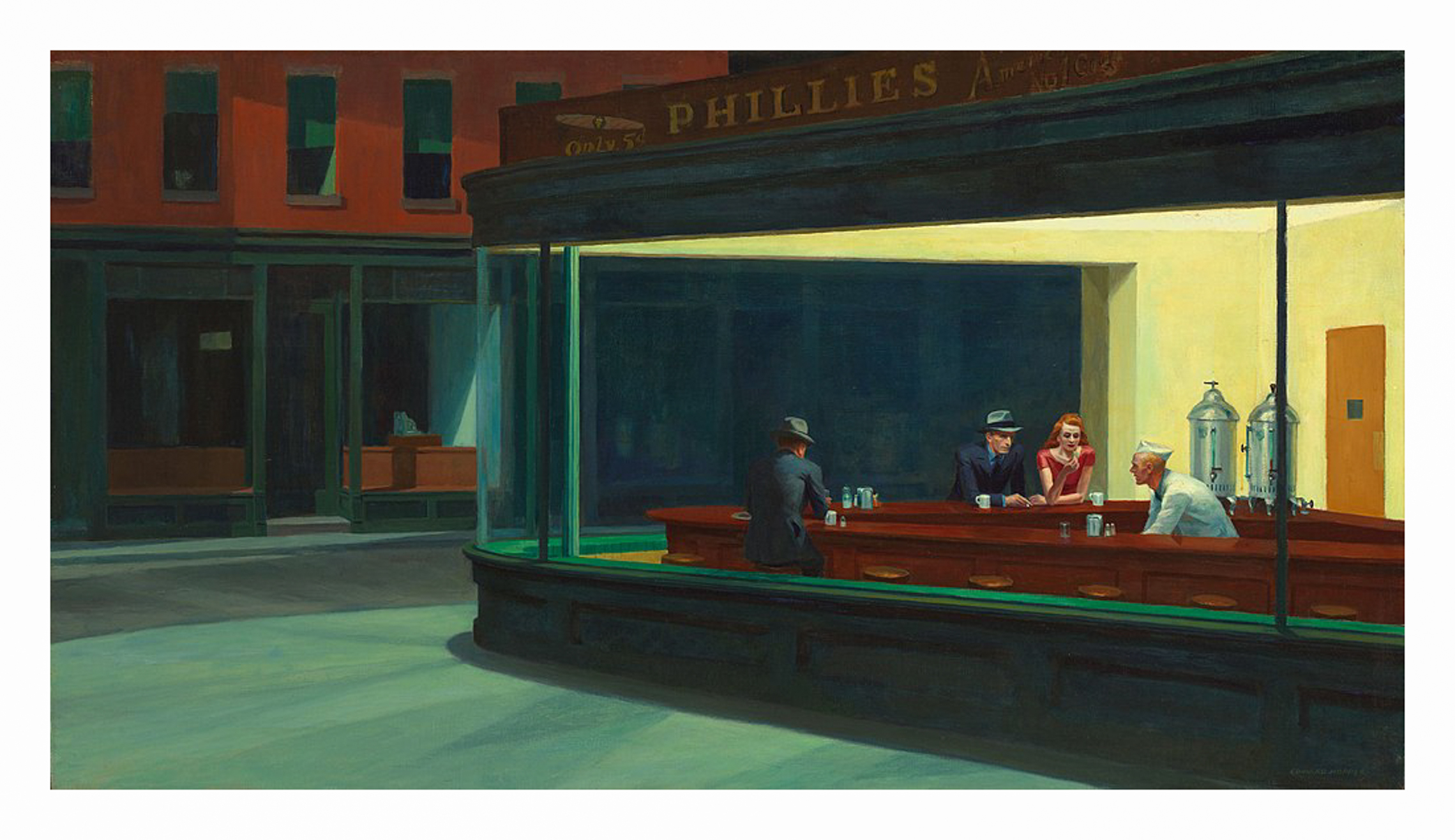
Both images suggest an atmosphere of detachment and fatigue — distancing the viewer from contact with any sense of cozy domesticity. In Hopper’s example we enter the brooding world of night-people rendered in frigid colors; even the lady’s flaming hair and red dress transmit chilliness. Customers seem remote from one another and self-contained.
In the Kansas image we glimpse the life of workmen. One wears a cowboy hat, the other a work cap; both guys have broad shoulders rippling under flannel shirts. Perhaps they are rail workers feeding themselves without much conversation, passing through an isolated town in an obscure corner of the Great Plains, whose prairies — stretching vast distances — reliably induce feelings of isolation.
In both pictures architecture seems opposed to the human subjects, appearing to oppress rather than shelter them. In Nighthawks we behold an interior lit by yellow light — normally a warm illumination — except here in Edward Hopper’s reality it tends toward cool greens and blues, giving us the impression we are deep underwater in ocean silence, and the people: our aquatic specimens. The converging lines of the huge window lead from right-to-left over the picture-plane, bringing us exactly nowhere; to a failed business, an abandoned storefront; upstairs the rooms seem unheated and unoccupied; through one window on the extreme left we can barely perceive a figure. It is vague; it could be a deformed human head, a cat, a piece of ceramic — we are left hanging.
Reynaldo’s looks more like a jailhouse than a restaurant. The roughly-textured exterior under threatening snow-clouds adds to this sense of rawness, as does the blood-red and garish-yellow stucco. The fifteen timber posts bristling from below roof-lines suggest a stockade — or fortress — places of confinement and introspection.
Both renditions grate on my nerves, while (paradoxically) giving me pleasure.